

Not sure where to start with your application for Social Work England registration?
Here are some tips, guidance, and practical advice to help you navigate the process
If you’re planning to work as a social worker in England, you must be registered with Social Work England. (If you’re moving from Australia, see my post Moving from Australia to the UK as a social worker for more background.)
You may have already looked at the Social Work England overseas applicant guidance. It contains a lot of useful information, but it can also feel overwhelming. SWE updates this guidance regularly, so it’s important to check for the most recent requirements.
Your qualification, university, and experience will all be considered. Your application is assessed by an assessor using their professional judgement, which means every application is unique. There’s no guaranteed formula for approval but I’ve supported many overseas social workers through the process, and I’ve gathered some helpful insights along the way.
- How long does the Social Work England registration take?
- How do I register as a social worker in England?
- Online application
- Qualification requirements
- What does Social Work England mean by ‘statutory experience’?
- Supporting documents
- Course information form and social work experience and training forms
- Updating skills and knowledge form
- Supporting letter
- References
- What else does Social Work England consider for international registration?
- Social Work England fees
- What if I need more help with my Social Work England international registration application?

How long does the Social Work England registration take?
SWE aims to complete an initial assessment within 60 working days (around three months). During this stage, you’ll be allocated a case officer who checks whether you’ve provided all the required information. It’s very common for applicants to be asked for additional documents at this point.
Once SWE has everything they need, they will send out reference requests and then move on to making a decision.
Most people are allocated a case officer sooner than 60 days, but this is only the initial stage of the process. Your application won’t be decided at this point. Overall, the process usually takes at least three months, and it’s not unusual for it to take six months or longer.
You can read more here: how long it takes to register with Social Work England?
My advice: start your application as early as possible.
How do I register as a social worker in England?
You will create an online account, collate all of your information, and pay a non-refundable scrutiny fee.
It sounds simple but for overseas social workers, the details can be confusing. What you need to provide depends on your qualification, experience, and where you’ve been practising.
The overseas guidance now includes a pre-application checklist and information about supporting documents, but it can still be difficult to work out exactly what SWE expects.
SWE will be assessing you against the professional standards and qualifying education and training standards guidance.
Online application
Once you create an account, you’ll complete an online form with:
- Personal details
- Qualification information
- Employment history
- Declarations about convictions, fitness to practise, safeguarding concerns, and health conditions
The online application is quite brief and on its own, it does not make it clear how much information you need to provide. The overseas guidance provides a lot more information about what is required.
Qualification requirements
To meet SWE’s qualification requirements, you must have:
- At least 200 days of supervised social work placements.
- Most Australian degrees include around 1,000 hours (about 142 days).
- SWE may consider your post‑qualified experience to make up the shortfall.
- Two contrasting placements, including at least one in a statutory setting
- If you didn’t complete a statutory placement, SWE may consider your work experience instead.
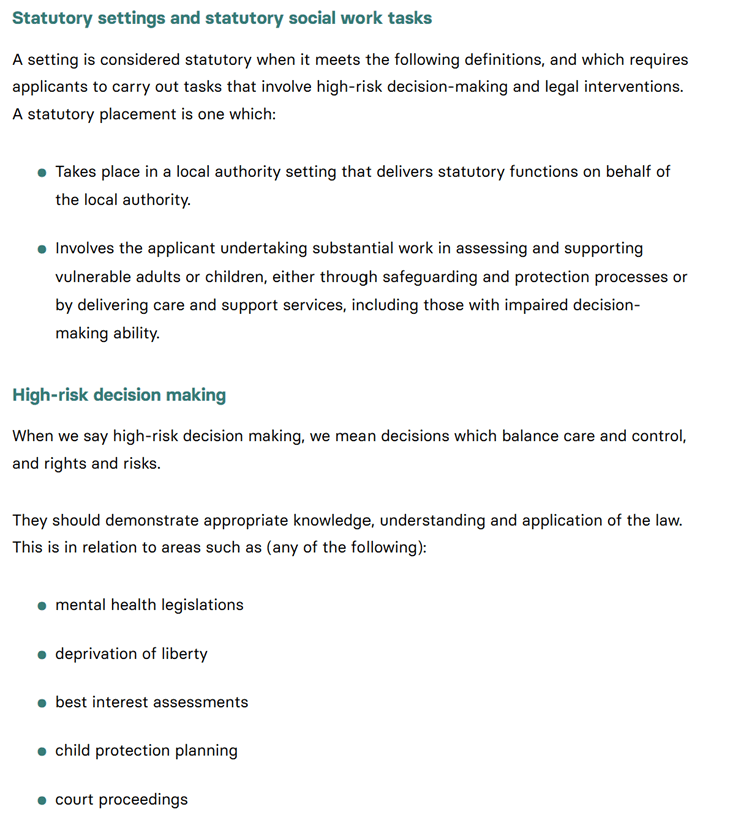
What does Social Work England mean by ‘statutory experience’?
Supporting documents
During the online application, you’ll upload a copy of your qualification. At the end, you’ll be asked if you have any additional documents but the system doesn’t tell you what these should be.
According to the overseas guidance, you must provide:
- A full academic transcript
- Your passport
- Certified translations if documents are not in English
SWE now uses an online identity verification service, which requires a biometric passport. If you can’t use the online service, you can upload your ID manually, but this may delay your application.
Make sure:
- All four edges of the document are visible
- Nothing is covering any part of the document
- You upload a photo of your passport, not a scan

Depending on your situation, you may also need to provide additional documents (explained below).
Course information form and social work experience and training forms
SWE has a list of overseas qualifications that have been assessed as meeting their standards.
If your qualification is not on this list, you must complete:
- A Course Information Form
- A Social Work Experience and Training Form (required since November 2025)
Your qualification must be an exact match to the course name, university name, and course end date on SWE’s list. If anything differs, you must complete the additional forms.
You can complete the Course Information Form yourself or ask your university to complete it. SWE will send the form to your university as part of their reference checks.
The Social Work Experience and Training Form helps SWE assess whether your experience compensates for any gaps in your qualification.


Updating skills and knowledge form
If you qualified more than 2 years ago, you need to complete an updating skills and knowledge form.
SWE require this because “social work is a constantly evolving profession” which is impacted by new legislation, updated policies, learning from case reviews and research, and changing cultural and social factors.
The form is divided into 3 sections. All applicants complete the personal details section and then either section 2 or section 3 depending on your circumstances.
If you have been practicing in a country where social work is regulated (where you have to be registered with a professional body to work as a social worker, such as New Zealand) within the last 12 months, you complete section 3 of the form.
If you have been practicing in a country where social work is not a regulated profession (such as Australia), you will need to complete section 2 of the form which requires a lot more information about your practice and training within the last 12 months.
In section 2, you are required to provide evidence of at least one of the following:
- Supervised practice
- Involves working under the supervision of a social worker in a social work related role where duties align with social work in the UK.
- Since November 2025, your supervisor must be registered with a social work regulatory body. This creates a significant challenge for applicants from countries without regulation. External supervision can help to overcome this barrier.
- Formal study
- Must be completed within the last 12 months
- Must be linked to a university
- Must require a social work qualification to enrol
- Very few applicants meet this requirement
- Private study
- Includes training courses, reading, and reflective learning
- Can only make up half of the required days
Most applicants use a combination of supervised practice and private study to complete this section of the form.
Supporting letter
If you are not required to complete the Course Information Form, Experience and Training Form, or Updating Skills and Knowledge Form, I recommend including a supporting letter.
This is your chance to:
- Highlight how you meet the professional and education and training standards
- Address any gaps (e.g., placement hours)
- Prevent SWE from requesting more information later
A clear supporting letter can save you months of delays.

References
SWE will contact:
- Your supervisor
- Your university
- Your registration body (if applicable)
You’ll be copied into the reference requests. If a referee does not respond within 28 days, your application will be closed. It’s your responsibility to follow up.
What else does Social Work England consider for international registration?
SWE will assess how your recent practice (within the last 12 months) aligns with social work roles in the UK.
UK social work is often more specific than in other countries (see my post about moving to the UK as a social worker). If your experience doesn’t directly match UK statutory work, for example, if you’ve been working as a counsellor, SWE may request more information.
You should provide any evidence of completing statutory social work tasks. Statutory social work tasks are those required by law. The statutory social work tasks should involve high-risk decision-making and applying legislation. The evidence could be from placements, employment or volunteering completed during or after your social work qualification. You will need to provide the organisation name and address, job/role title, start and end dates, short summary of the role, and supervisor’s email contact.
If you are not able to provide the required evidence, you might be required to take a test of competence or a period of adaptation.
Social Work England fees
- £670 non‑refundable scrutiny fee (increases annually; next increase is 1 December 2026) to be paid when you submit your application
- £122 annual registration fee (also increases annually) to be paid once your application is approved. All social workers registered with SWE pay this fee every year.
Important: You must pay the registration fee within 10 working days of approval. If you miss the deadline, your application will be closed and you’ll need to start again.
What if I need more help with my Social Work England international registration application?
Sometimes there are additional difficulties. Your social work degree might not meet Social Work England’s requirements, for example not completing enough placement hours. Or your current role might not be considered a social work role in the UK. These hurdles make the process more complicated and may delay your application being approved.
If you have started the Social Work England registration process and you’re unsure of what to include, send me a message below. I will share more detailed experiences from social workers who had their applications approved, and who were happy to share their stories to help others navigate this process.
You can also DM me, connect with me on LinkedIn or email me.
Kristin


 Work and Life in the UK
Leave a reply to Frequently Asked Questions About Living and Working in the UK – Work and Life in the UK Cancel reply